
Data Encapsulation & Decapsulation in Networking

Published on November 21, 2026

Encapsulation & Decapsulation

Share this Article

Close your gaps in technology.

Achieve your goals with solutions that fit your budget.

Data transmission in a network doesn’t move in one raw lump. Instead, protocols wrap data in control information as it moves down the sender layers (encapsulation) and unwrap it as it moves up the receiver layers (decapsulation).

Data encapsulation and decapsulation run simultaneously over a network to enable effective communication. 

Encapsulation (Sender Side: Top to Bottom)

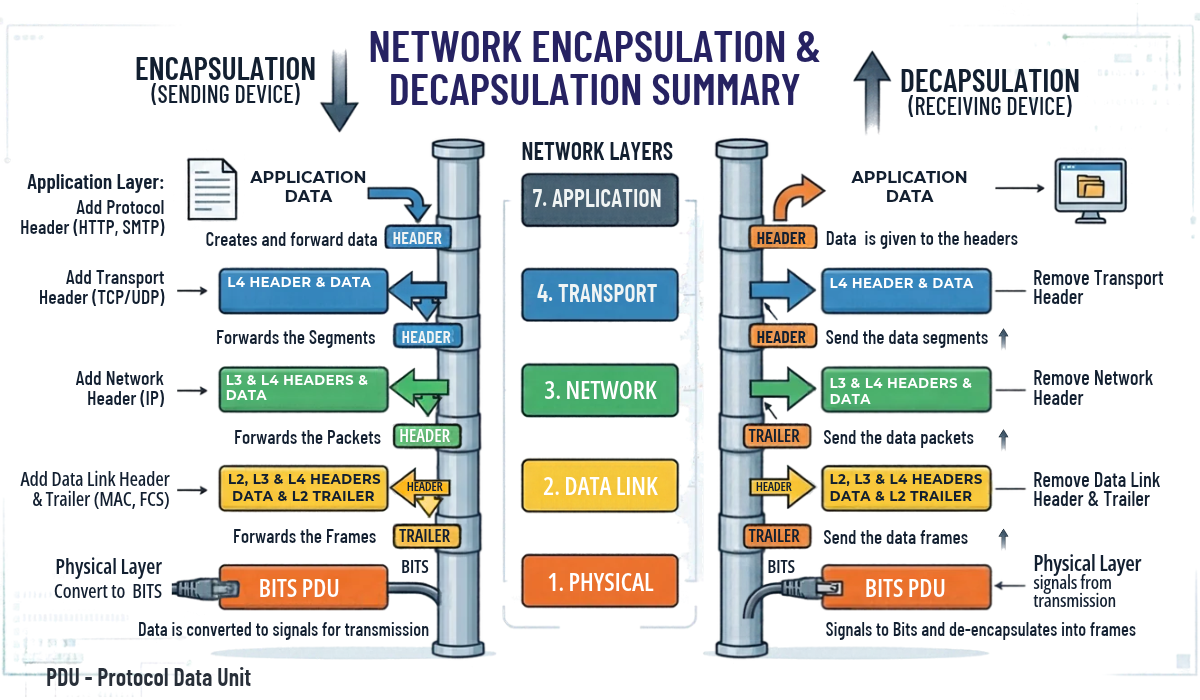
Encapsulation is the process of taking user data and adding protocol-specific headers (and sometimes trailers) at each layer as it moves from higher layers down to the physical medium.

It follows this process.

  • Application layer (including Presentation, and Session):

    The user information or application payload is created and forwarded to the Transport layer.

  • Transport Layer:

    Adds a transport header, which is a segment (TCP) or Datagram (UDP),  with source & destination ports, sequence/acknowledgment numbers. Hence, it forwards the data to the Network Layer.

  • Network Layer:

    Further, this layer adds a network header (e.g., source & destination IP addresses, TTL) to the received Data segment from the Transport layer. Hence, data is passed to the Data Link Layer.

  • Data Link Layer:

    Similarly, this layer adds additional fields of data, frame header (e.g., source & destination MAC addresses) and a trailer (e.g., Frame Check Sequence / FCS for error checking).

  • Physical Layer:

    Finally, this last layer converts the frame received from the previous layer into bits carried by electrical pulses, light signals, or radio waves for transmission over the medium.

Encapsulation & Decapsulation

Figure 1: Encapsulation and Decapsulation in Networking

Decapsulation (Receiving Side: Bottom to Top)

Decapsulation is the reverse process. When signals arrive at the receiving device, each layer reads and strips off its corresponding header/trailer and passes the remaining payload up to the next layer.

  • Physical Layer:

    The process starts here, where the physical layer reconstructs received raw signals into bits and decapsulates the data into a frame. Then forwards it to the data link layer.

  • Data Link Layer:

    This layer reads the frame header and trailer to validate error checks (such as FCS), verifies MAC addresses, and passes the packet up to the above layer.

  • Network Layer:

    Similarly, this layer reads its header, checks IP addressing and routing details, and passes the segment/datagram up to the Transport layer.

  • Transport Layer:

    At this stage, the Transport Layer checks port demultiplexing, strips its header, and passes the data up to the Application layer.

  • Application layer (including Presentation, and Session):

    Finally, this last layer completely decapsulates and delivers the clean data to the target application or user interface.

Protocol Data Unit (PDU)

PDU is the specific name assigned at each layer to the encapsulated data travelling down the OSI model.

LAYER PDU

Application

Data

Presentation

Data

Session

Data

Transport

Segment / Datagram

Network

Packets

Data Link

Frames

Physical

Bits

Figure 2: Networking Protocol Data Unit