
Understanding the OSI Model: 7 Layers of Networking
Published on November 21, 2026
Share this Article
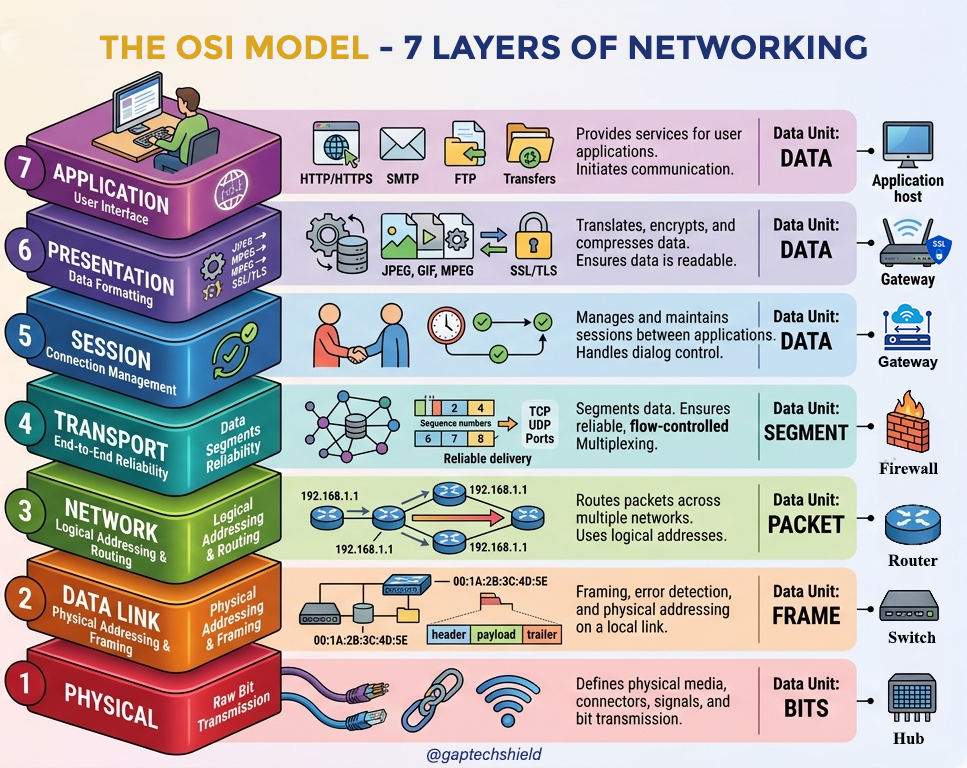
The Open Systems Interconnection (OSI) Model is a conceptual seven-layer framework established by the International Organisation for Standardisation (ISO) to describe data transmission across a network.
Specifically, it describes data from software applications across physical network media to another device. Each layer is assigned specific responsibilities, and the devices to carry them out. The layers, from top (sender) to bottom (receiver), are initiated as APSTNDP.
Layer 1: Physical Layer
This is the foundation of the OSI model, acting as the bridge for actual physical connections between devices. Its core responsibility is to define the hardware, signals, and transmission of bit streams (0s and 1s).
Its transmission speed is measured as bits sent per second, b/s. Common devices operating at this level include: Hubs, Repeaters, Modems, Network Interface Cards (NICs), and Cables. It translates incoming bits into Frames to be processed by the Data Link layer.
Layer 2: Data Link Layer (DLL)
This layer bridges the physical hardware and the logical network, ensuring reliable node-to-node delivery of data. Its primary goal is to ensure error-free data transfer across the physical medium.
Also, it converts the data stream into signals bit by bit and sends it over the underlying hardware. This layer data packaging is Framing, that contain the source and destination addresses. Common devices operating at this level are Switches and Bridges.
The DLL has two sublayers: Logical Link Control (LLC) and Media Access Control (MAC).
-
Logical Link Control (LLC);
Plays the role of an interface used by upper-layer protocols to share a single physical data link. LLC manages communication between the devices and error control.
-
Media Access Control (MAC):
Controls how devices access the medium to transmit data.
Layer 3: Network Layer
This layer controls logical addressing, provides packet routing and forwarding across multiple interconnected networks. The primary goal is the use of routing protocols, such as BGP, OSPF, EIGRP, and RIP, to determine the best path for data travel. The data packaging at this layer is packets. The main device at this level is the Router.
The IP protocol, which helps to communicate end-to-end devices over the internet, resides in this layer. It comes in 2 versions;
- IPv4,that is 32-bit numeric addresses and
- IPv6, which is a 128-bit alphanumeric addresses.
Layer 4: Transport Layer
This layer provides end-to-end delivery of data between hosts which may or may not belong to the same subnet. Its core goal is to ensure data is received in the same sequence in which it was sent. The transport layer data unit is segments. It receives data from the upper layer, starting from the Application layer, and breaks it into smaller segments and sends it to the Network layer for delivery.
Port numbers are the addressing used at this layer to identify a peer host on a remote network. Examples are Port 80 for HTTP and Port 443 for HTTPS.
The two main protocols at this layer are:
-
1. Transmission Control Protocol (TCP):
It’s connection-oriented and provides reliable communication between two hosts through acknowledgements, error recovery, and flow control. It can perform the roles of both receiver and sender, that is, a full-duplex server. TCP is one of the most important protocols of the Internet Protocol Suite, and it’s the most widely used, including on the Internet.
-
2. User Datagram Protocol (UDP):
It provides unreliable communication between two hosts without a formal connection. This makes it faster, but with no data delivery guarantee. This protocol is simple and good for query-based communications with data flow in one direction. UDP is used for data transmission in a few applications, including Domain Name Services(DNS), Kerberos, and Simple Network Management Protocol(SNMP).
Layer 5: Session Layer
The session layer plays the role of permitting and maintaining sessions (dialogues) between two devices over a network. Its primary functions include: session setup, maintenance, and terminating connections between applications. This layer monitors session identification to verify the communicating parties, so only designated parties can participate. Thus, ensures a secure connection to control access to session information.
Furthermore, the session layer ensures synchronization with data as its data unit. This is done by inserting checkpoints into the data stream so an incomplete transfer can resume from the last checkpoint instead of restarting.
A real scenario of the session layer is that, when browsing, it maintains the active link between the browser and server to be open and performs data conversion.
Layer 6: Presentation Layer
This is layer 6 that ensures that data transferred is formatted, secured, and readable by the receiving system. It handles data translation, which converts the Application layer into a standard format understandable by the receiving application.
The presentation layer is also focused on securing the data by encryption, from plaintext to ciphertext, and decryption, vice versa, through the TLS/SSL protocol. Also, handles data compression, to reduce the number of bits needed for transmission, and formatting using standards such as JPEG, GIF .
Layer 7: Application Layer
This is the OSI model's topmost layer that acts as the interface between the user's applications and network services. It is the producer of the data to send and brings out the data received from the lower layers.
This layer makes use of communication protocols like HTTP/HTTPS for the Web, SMTP for Email, DNS for Domain Name Resolution, and FTP for File Transfer.
Also, it offers the following functions:
-
File Transfer, Access, and Management (FTAM),
The FTAM enables the services to handle files such as retrieval, management, and manipulation on remote computers.
-
Network Virtual Terminal (NVT):
This is for the services that enable users to access remote hosts as if physically present.
-
Directory Services (DS),
This enables services capable of matching names with addressing information.


